CNC Rapid Prototyping in China | Fast & Precision CNC Prototypes
CNC Rapid Prototyping: Fast and Precision CNC Prototypes from China
A CAD design can look perfect on the screen and still fail when the first physical part is assembled. A hole may be slightly out of position, two components may not fit, a wall may be too thin, a thread may need adjustment, or the selected material may not perform as expected.
This is where CNC rapid prototyping becomes valuable. Instead of waiting for mass production to discover these problems, engineers can turn the CAD design into a real machined component, test it, make adjustments, and move toward production with much lower risk.
For companies developing new products, the goal is not simply to get a prototype quickly. The prototype needs to be accurate enough to test, made from the right material, delivered on schedule, and priced reasonably. China has become a major source for this type of manufacturing because buyers can access a large CNC machining supply chain and a wide range of precision manufacturing capabilities. GeJiGeJi helps international buyers find Chinese CNC manufacturers for rapid prototyping, custom machining, and low-volume production.
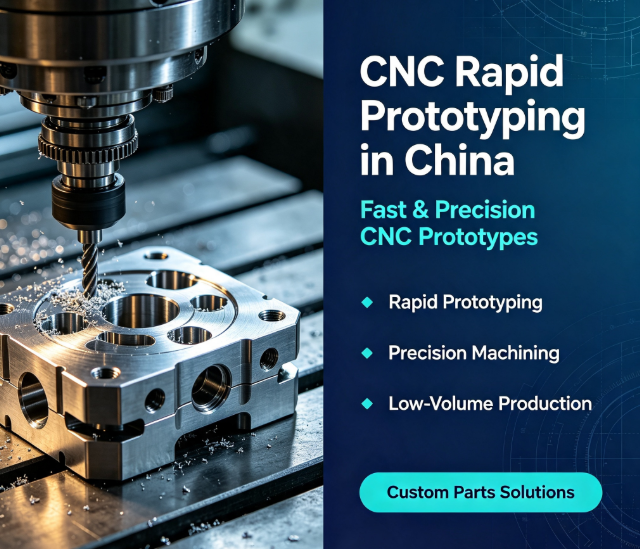
What Is CNC Rapid Prototyping?
CNC rapid prototyping is the use of CNC milling, CNC turning, or other CNC machining processes to manufacture physical prototypes directly from CAD files.
Unlike a prototype made only for visual inspection, a CNC-machined prototype can be produced from the same or similar engineering materials used in the final product. This allows engineers to evaluate dimensions, fit, strength, surface finish, threads, holes, moving components, and other functional requirements before committing to larger production quantities.
Typical CNC prototype materials include:
Aluminum
Stainless steel
Brass
Copper
POM
Nylon
ABS
Polycarbonate
Acrylic
PEEK
Other engineering plastics
GeJiGeJi connects global buyers with Chinese manufacturers capable of machining different metals and engineering plastics according to specific drawings, tolerances, quantities, and finishing requirements.
Why Use CNC Rapid Prototyping?
The biggest benefit is not simply producing a part faster. It is finding problems earlier.
A physical prototype allows engineers to verify whether the design works under real conditions before production costs become significant.
Check Assembly Before Production
A prototype can reveal problems that are difficult to identify from CAD models alone.
For example:
Two components interfere during assembly.
A hole is too small for the required fastener.
A threaded connection does not work correctly.
A tolerance is unnecessarily tight.
A machined corner is difficult to manufacture.
A component is heavier than expected.
A surface finish does not meet the application requirements.
Fixing these issues at the prototype stage is much cheaper than correcting hundreds or thousands of finished parts.
A capable Chinese CNC manufacturer can also provide DFM feedback before machining begins, helping engineers adjust the design for better manufacturability and lower machining costs.
GeJiGeJi helps buyers find manufacturers that can provide both CNC machining and engineering support, rather than simply accepting a CAD file and producing the part.
How Fast Is CNC Rapid Prototyping?
Prototype speed depends on the part geometry, material, tolerance, quantity, finishing requirements, and manufacturing process.
A typical workflow looks like this:
CAD File → DFM Review → Quotation → Programming → CNC Machining → Inspection → Surface Finishing → Delivery
Simple parts can move through this process quickly, while complex multi-axis components may require more engineering preparation.
For urgent projects, some manufacturers available through GeJiGeJi provide 24-hour rapid prototype response and can complete certain prototype projects within 3–5 days.
For complex parts, fast quotation is also important. Some GeJiGeJi manufacturers can complete complex-part quotations within approximately 72 hours, depending on the technical information provided.
This can significantly reduce the time between design completion and physical product testing.
CNC Rapid Prototyping for Precision Parts
Not every prototype requires extremely tight tolerances. However, many mechanical prototypes must fit with other components or reproduce critical production dimensions accurately.
CNC machining is well suited to these applications because cutting parameters, tooling, machine capability, inspection methods, and production processes can be controlled precisely.
For certain precision machining projects, Chinese manufacturers on GeJiGeJi can provide machining capabilities down to approximately ±0.005 mm, depending on the material, geometry, machine, tolerance location, and inspection requirements.
For high-precision prototypes, buyers should not only ask for the smallest achievable tolerance. They should identify the critical dimensions that actually affect function.
For example, a prototype may have:
±0.005 mm tolerance on a critical bearing seat
Standard tolerance on non-critical external dimensions
Specific positional tolerance for mounting holes
Controlled surface roughness on sliding surfaces
Additional inspection requirements for critical features
This approach can reduce unnecessary machining costs while maintaining functional accuracy.
CNC Prototyping Materials Matter
Choosing the right material is an important part of prototype development.
An aluminum prototype may be suitable for lightweight structural components, housings, brackets, and mechanical parts. Stainless steel can be selected when corrosion resistance and strength are important. Brass and copper may be required for electrical or thermal applications.
Engineering plastics are also widely used in CNC prototyping.
Materials such as POM, nylon, ABS, PC, and PEEK can be used for components requiring properties such as:
Low weight
Electrical insulation
Low friction
Wear resistance
Chemical resistance
Dimensional stability
High-temperature performance
The material should be selected according to the actual function of the component rather than simply choosing the cheapest option.
GeJiGeJi gives buyers access to Chinese manufacturers with experience in machining a wide range of metals and engineering plastics, making it easier to match the prototype material with the final application.
CNC Rapid Prototyping vs. 3D Printing
3D printing is excellent for producing highly complex shapes quickly, especially during the earliest design stages.
CNC machining becomes more attractive when the prototype needs to represent a real machined component with production-grade material, tight dimensional control, and a high-quality surface finish.
| Requirement | CNC Rapid Prototyping | 3D Printing |
|---|---|---|
| Metal prototype | Excellent | Process dependent |
| Engineering plastic | Excellent | Excellent |
| Dimensional accuracy | Very high | Technology dependent |
| Surface finish | Excellent | Technology dependent |
| Functional mechanical testing | Excellent | Good |
| Production-grade material | Excellent | Process dependent |
| Complex internal geometry | Limited | Excellent |
| Low-volume production | Excellent | Excellent |
For early concept validation, 3D printing may be the fastest option.
For functional prototypes that need to be assembled, tested, measured, or used under realistic operating conditions, CNC machining is often a better choice.
How Much Does CNC Rapid Prototyping Cost?
CNC prototype pricing depends on more than the size of the part.
The main cost factors include:
Material
Part complexity
Machining time
Number of setups
Number of axes required
Tolerance requirements
Surface finish
Quantity
Tooling requirements
Inspection requirements
Secondary processing
Shipping
A simple aluminum bracket may require only a few machining operations, while a complex five-axis component with tight tolerances and special finishing can require substantially more time.
For this reason, the cheapest quotation is not always the lowest-cost solution.
A supplier that provides a slightly higher initial quotation but identifies design problems, improves manufacturability, and delivers correctly on the first attempt can reduce the total project cost.
GeJiGeJi allows global buyers to compare Chinese manufacturing capabilities and find suppliers offering competitive CNC machining prices without sacrificing the technical requirements of the project.
How to Prepare a CNC Prototype RFQ
A clear RFQ can significantly reduce quotation time and avoid unnecessary back-and-forth communication.
Provide the manufacturer with:
1. 3D CAD File
STEP or STP files are commonly used for CNC machining quotations.
2. 2D Engineering Drawing
Include critical dimensions, tolerances, threads, surface roughness, and other technical requirements.
3. Material
Specify the exact material and grade whenever possible.
4. Quantity
Tell the supplier whether you need one prototype, five prototypes, twenty parts, or a larger pilot-production batch.
5. Surface Finish
Specify requirements such as anodizing, powder coating, polishing, plating, brushing, or other finishing processes.
6. Inspection Requirements
If certain dimensions require inspection reports or CMM measurement, specify them before production.
7. Delivery Requirement
Provide the destination and required delivery date so the manufacturer can evaluate the complete project schedule.
The more complete the RFQ, the more useful the quotation will be.
How to Choose a CNC Rapid Prototyping Manufacturer in China
China has thousands of CNC machining companies. The challenge is not finding a factory. The challenge is finding a factory that is suitable for your specific part.
Before placing an order, evaluate the following factors.
Manufacturing Equipment
Check whether the supplier has the machines required for the geometry.
Depending on the project, this may include:
3-axis CNC milling
4-axis CNC machining
5-axis CNC machining
CNC turning
Swiss machining
Wire EDM
EDM
Grinding
A supplier with the wrong equipment may still quote the job, but the resulting price, tolerance, or lead time may not be competitive.
Quality Control
Ask how critical dimensions are inspected.
For precision prototypes, suppliers may use equipment such as:
CMM
Height gauges
Micrometers
Calipers
Optical measuring equipment
Surface roughness testers
Quality control should be part of the production process rather than something performed only after the part is finished.
Engineering Capability
A good prototype supplier should be able to identify potential manufacturing problems before production.
Useful DFM feedback may include:
Hole diameter recommendations
Wall thickness recommendations
Tool access problems
Excessive tolerance requirements
Deep pocket machining issues
Internal corner limitations
Material selection
Surface finishing limitations
This engineering support can save more money than simply finding the lowest machining price.
Prototype and Production Capability
Ideally, the same supplier should be able to support the project after prototype approval.
A typical development path is:
Prototype → Design Modification → Second Prototype → Small Batch → Production
Working with a manufacturer that can support multiple stages reduces the need to qualify a completely new supplier after the prototype has been approved.
Why Source CNC Rapid Prototypes from China?
China offers a combination of manufacturing capacity, engineering resources, material availability, processing options, and competitive pricing that is difficult to match in many other markets.
A CNC prototype project may involve more than machining alone.
Chinese manufacturing suppliers can often provide:
CNC Machining + Surface Finishing + Heat Treatment + Inspection + Assembly + Packaging + International Shipping
This integrated supply chain can simplify supplier management for overseas buyers.
The bigger challenge is identifying the right manufacturer from a large supplier base.
That is where a manufacturing sourcing platform can provide practical value.
Find CNC Rapid Prototyping Manufacturers on GeJiGeJi
If you are sourcing CNC rapid prototyping from China, GeJiGeJi provides a direct way to explore Chinese manufacturing suppliers for prototypes, custom CNC parts, and low-volume production.
Instead of contacting factories one by one without knowing whether they match your requirements, buyers can use GeJiGeJi to find manufacturers based on their project needs.
Manufacturers on the platform can support projects involving:
Rapid CNC prototyping
Precision CNC machining
CNC milling
CNC turning
Custom machined parts
Plastic CNC machining
Metal CNC machining
Low-volume production
Complex CNC components
Engineering prototype development
Depending on the manufacturer and project requirements, buyers can also find capabilities including 3–5 day rapid prototyping, 24-hour prototype response, precision machining around ±0.005 mm, competitive pricing, engineering support, and complex-part quotation within 72 hours.
The important point is not simply finding a Chinese factory that can operate a CNC machine. It is finding a manufacturer that can produce your specific part to the required quality, price, tolerance, material, and delivery schedule.
From Prototype to Production
A successful prototype should make the next manufacturing stage easier.
Once the prototype has been tested and approved, the same design can move into small-batch production or larger-volume manufacturing.
During this transition, the manufacturer should be able to maintain:
Consistent material
Stable machining processes
Repeatable tolerances
Reliable inspection
Consistent surface finishing
Controlled production lead times
This is why supplier selection matters even for a one-piece prototype.
A prototype manufacturer is not only producing one part. They may become the manufacturing partner for the entire product development cycle.
Start Your CNC Rapid Prototyping Project with a Chinese Manufacturer
For companies developing new products, CNC rapid prototyping provides a practical way to turn CAD designs into functional parts, identify design problems early, and validate a product before larger production investment.
China offers a broad range of CNC machining capabilities and competitive manufacturing resources. The key is choosing a supplier that matches the technical requirements of the project rather than simply choosing the lowest quotation.
If you need CNC rapid prototyping in China, use GeJiGeJi to find suitable Chinese manufacturers for your project.
Upload your CAD files, define your material, quantity, tolerance, finishing, and delivery requirements, and compare manufacturers based on what your project actually needs.
GeJiGeJi — China CNC Machining Hub
Connecting Global Buyers with China’s Best Manufacturing Capabilities.